Know what to do with every return.
Reruta checks the photos of each returned item, then decides whether to restock it, send it to a new buyer, discount it, refund it or ask a person. You see the reason for every call.
Returns cost UK retailers an average of 20% of revenue.
Reverse logistics, warehouse processing and restocking silently erode margins on every returned item.
High cost of processing
The cost is often hidden across logistics and restocking, so many retailers simply absorb the loss instead of measuring it.
Returned items rarely recover full value
Even pristine, tagged returns get discounted or written off. The original sale price is lost the moment the return is initiated.
The regulatory pressure is mounting
EU regulation now bans destroying returned garments for large retailers. UK legislation is expected to follow.
From a return coming in to a decision, in three steps
A return comes in
The customer starts a return and uploads photos of the item: front, back and the tag.
The photo check looks
Two AI models read the photos against a written checklist. If they disagree or are unsure, a person decides.
The engine decides
It combines the condition with your stock and recent sales, and recommends the best option with the reason.
Seven possible decisions, each with its reason
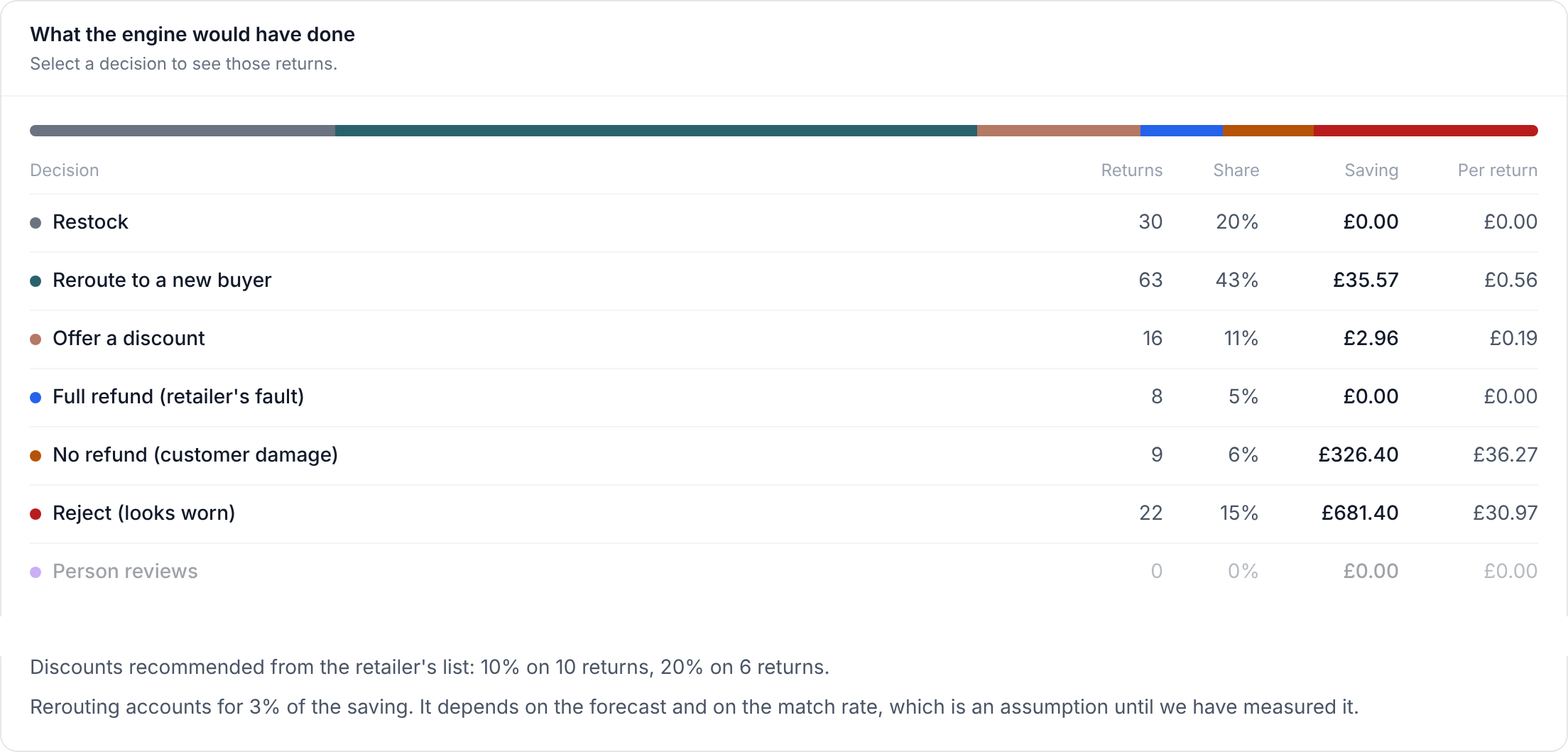
No black box. Open any return and you see what the engine looked at and what it would have cost to do something else.
Restock
There is enough stock already. It goes back on the shelf.
Reroute to a new buyer
Stock is thin and demand is strong, so it goes straight to the next buyer.
Offer a discount
Demand is weak. A discount you have approved sells it sooner.
Full refund
Damaged and it was your fault. The customer is refunded in full.
No refund
Damaged by the customer. Your policy decides what follows.
Reject
Clearly worn. Only where your returns policy allows refusing it.
A person reviews
The check is not sure enough, so someone on your team decides.
Your rules
The discounts on offer, how sure the check must be and what your policy allows are all set by you.
A photo check you can trust before you rely on it
Two different AI models judge every item on a written checklist: stains, holes, stretching, missing tags.
Starts in shadow mode
It checks every new return in the background and changes nothing. You see how often it is right before you let it act.
You mark the truth
Say whether each item really was in bad condition. The page shows how many good items it would have rejected and how many bad ones it missed.
A person stays in charge
When the models disagree or are unsure, the return goes to your team. It approves clear good items at most, and never refuses a return on its own.
See it on your own returns
Send us last year's returns and orders. We run them through the engine and show you, return by return, what would have been done differently and what it would have saved.
- 1Tell us about your brandFill in the form. We reply within two working days.
- 2Send two filesA list of your returns and a list of your orders. We give you a template, and any layout works.
- 3Get your resultsA private walk-through of the engine on your data, with the assumptions open for you to change.
Questions brands ask
Do you need my customers' personal details?
No. We only need order and return details: product, size, price, dates, reason, condition and what happened to the item. Please leave out names, emails and addresses.
Do I have to change how I handle returns?
Not to test it. We run the engine on your past returns and show you what it would have decided. Changing anything live is a separate decision, and you stay in control of it.
How accurate are the numbers?
They are estimates built from your own history, with every assumption shown and editable. We do not use hindsight in the headline figure, because a real return would not have it either.
Will it refuse returns by itself?
No. The photo check can approve a clearly good item. Anything unclear goes to a person, and it never declines a return on its own.
What does it cost to try?
Nothing. Testing your past returns is free.